In various baking entries, people complain that their puto did not rise or that their cake was too dense or some other thing that relates to the texture of the product. While baking is not as formulaic as some people claim (I’ve made mistakes and was able to salvage my baking projects), it is nevertheless true that there are certain basic skills that are useful to learn in order to successfully complete any baking project. There is more to baking than knowing how to mix ingredients. Using standard measuring cups and spoons; knowing the difference between loosely packed and firmly packed brown sugar or the difference between a level teaspoonful and a rounded teaspoonful; knowing the fundamental techniques like sifting, creaming, cutting and folding… Then, there’s the matter of beating egg whites. This was something I learned over many years. Back in high school, I did not have visual guides and not until I bought a tiny book with step-by-step photos of the various stages of beating egg whites did I realize why my chiffon cakes had always been rubbery instead of light and airy.
I baked a mango cream pie yesterday and instead of integrating the following photos with the recipe entry, I am posting them as a stand alone entry so that I can refer to this post in all future recipe entries that call for beaten egg whites.
You can beat egg whites manually with a wire whisk or even with a fork but be prepared to experience an aching arm. Beating egg whites can take as long as 10 minutes so an electric mixer is more than convenient.

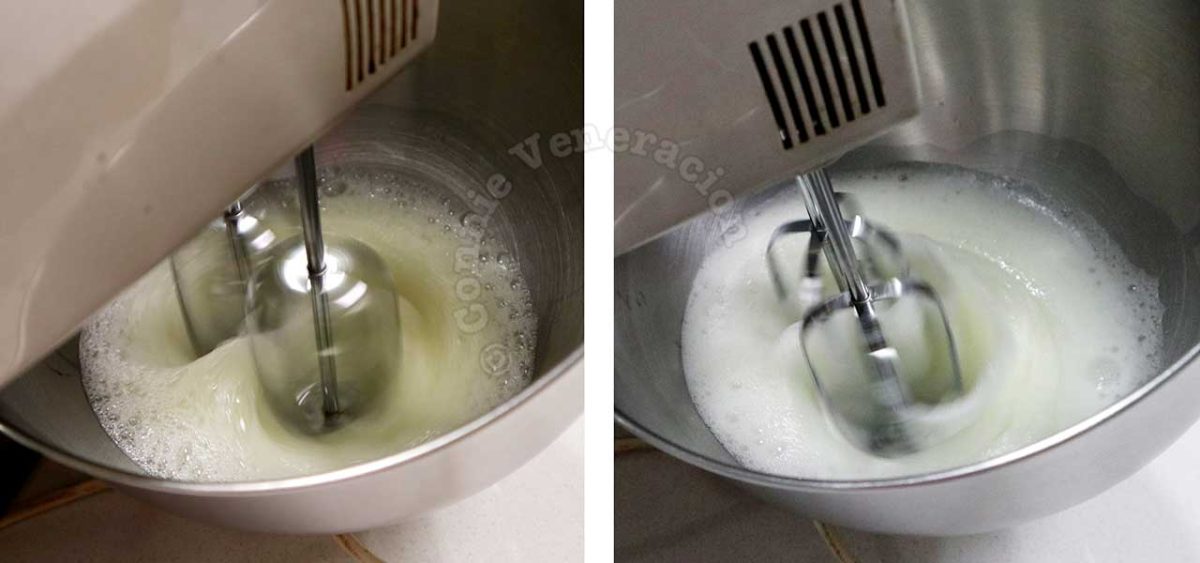
That is one egg white in the mixing bowl above. Out of the shell and after separating the egg yolk, the egg white is a clear pale yellow.

Within seconds of beating the egg white, air bubbles start to form.

After a minute or so, more air bubbles form, the mixture loses its yellowish hue and starts to acquire a creamy color.

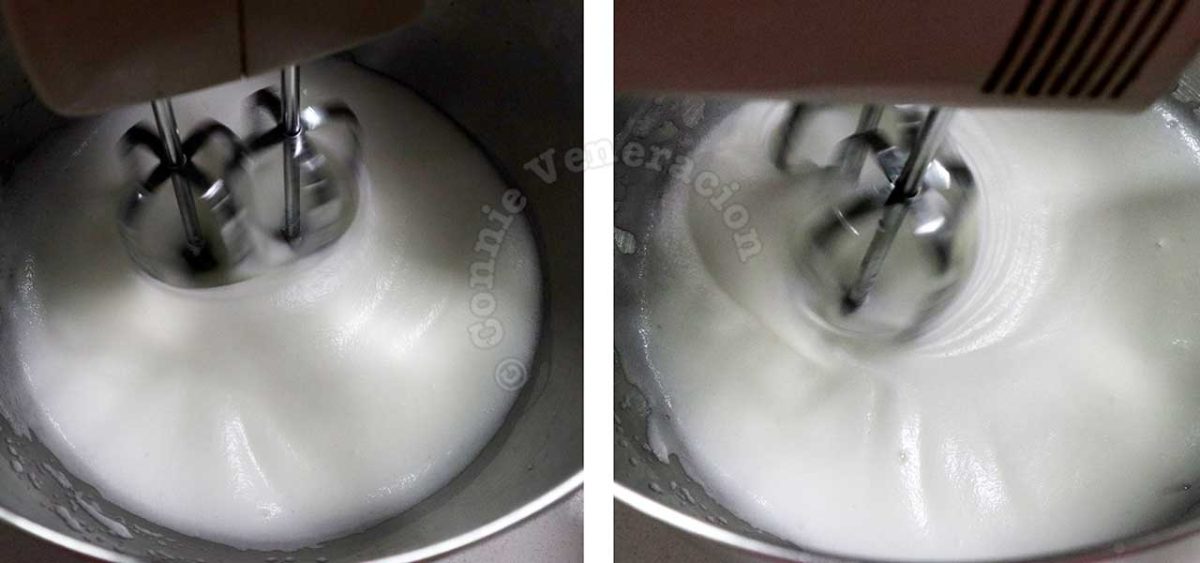
After another minute or so, the air bubbles become finer, the mixture starts to acquire volume and turns white.

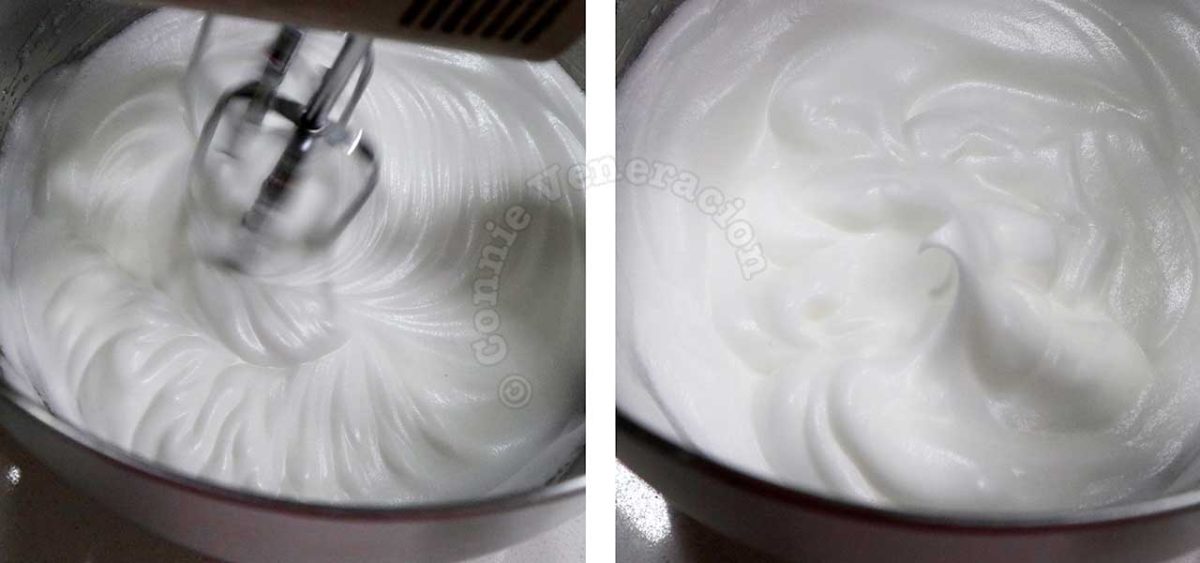
During the next stage, the bubbles start to turn invisible to the naked eye as they continue to get finer and finer. The volume of the mixture has more than doubled at this point.

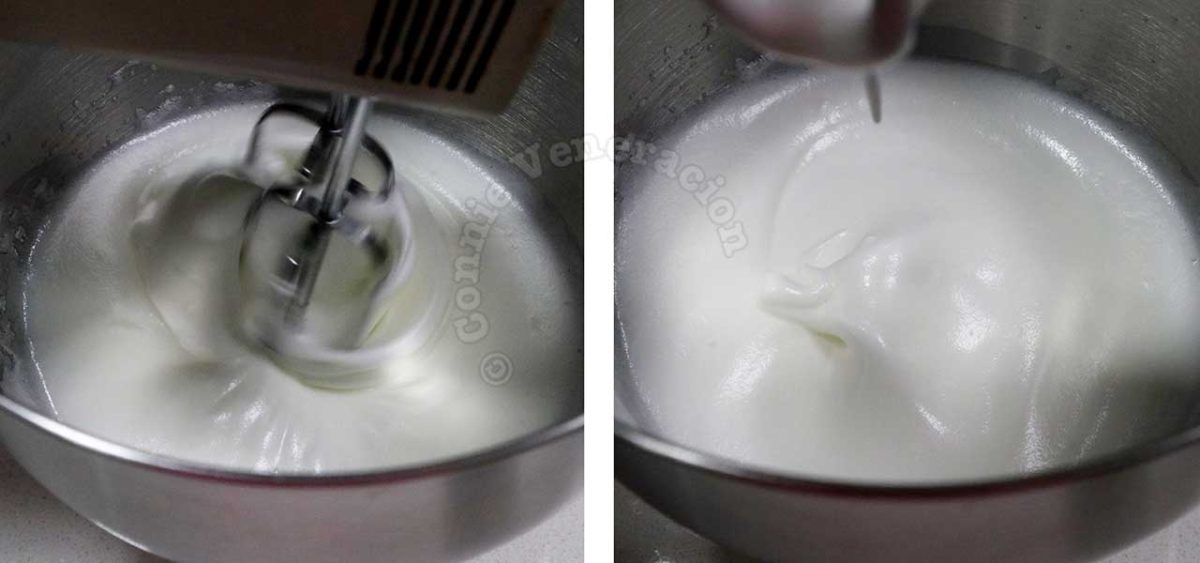
Then, peaks begin to form. Notice the mounds near the beater? Those are the peaks that are beginning to take shape.

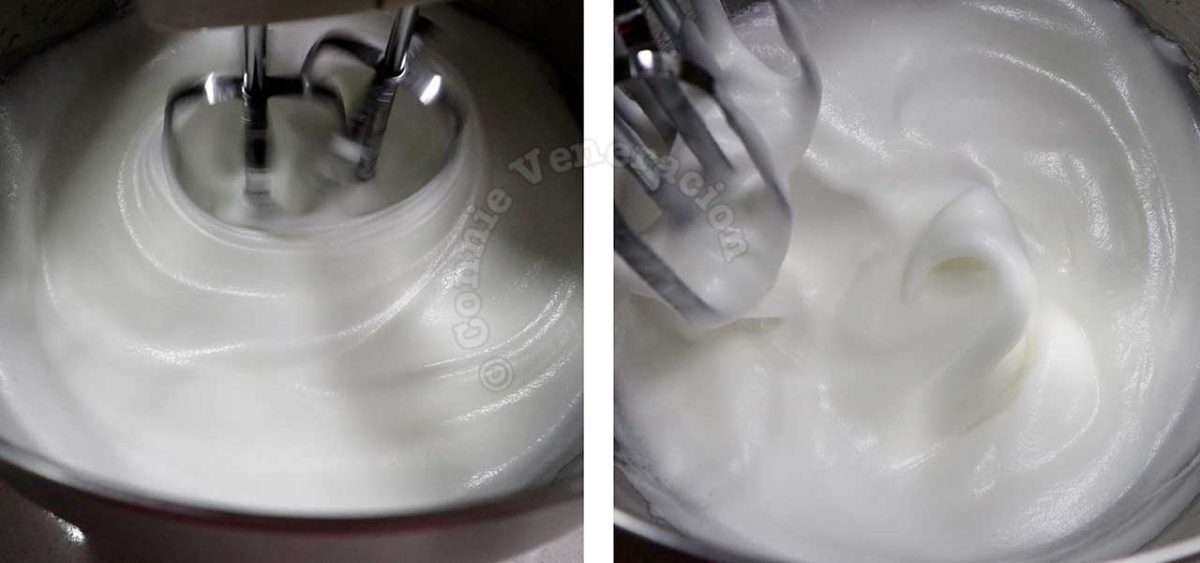
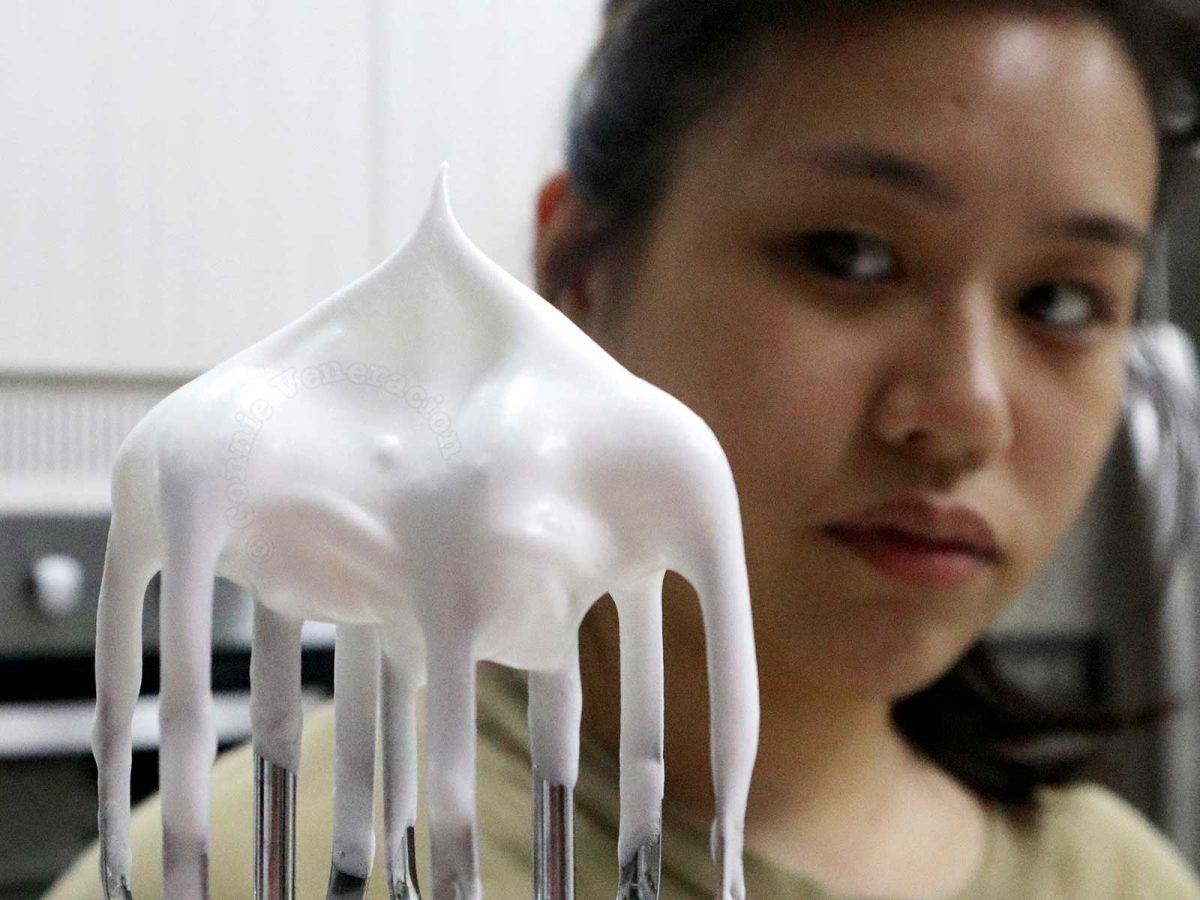
After that, it’s just a matter of deciding when to stop beating the egg whites depending on whether the recipe calls for soft peaks or stiff peaks. To determine whether you are in the soft peaks stage, turn off the mixer, lift the beaters and check the appearance of the peaks. If the tips of the peaks droop down but the peaks themselves stay erect, that’s the soft peak stage.
If the peaks stay upright all the way, then you have stiff peaks. Now, there are two stages in the stiff peaks stage that are a ittle difficult to show through photos. The first is the “stiff but not dry” peaks and the second is the “stiff and dry” peaks. The “stiff but not dry” comes first and the “stiff and dry” follows. The difference between the two is that in the “stiff but not dry” stage, the surface of the mixture is still glossy. The glossy appearance is lost as the egg whites enter the “stiff and dry” stage.
So, there. If you decide to make puto, chiffon cake or tiramisu, you now know that there is more to beating egg whites than stirring them with a wire whisk.


Thanks, Connie! This is another lesson most of us may have taken for granted. I will certainly remember every detail you said. And your visuals are excellent, ha.
Can you imagine me holding the hand mixer with my left hand and my camera with my right hand? LOL I couldn’t put up the tripod because everyone was moving in and out of the kitchen.
thankss again!!
i really don’t know how to repay you for these valuable lessons, so minsan nagciclick nalang ako ng maraming ads from google adsense, hehehe.
LOL Al, thank you!
with you, everything looks easy ! with me, everytime i beat egg whites, i noticed that there’s always a liquid resting at the bottom of the bowl. I don’t know why .
La Parisienne, that usually happens when the eggs are cold. Try putting them on the counter for a couple of hours before beating.
so yun pala yun! hehehe… ako din laging me liquid pa pg ng bbeat ng eggwhites e. tas ngging watery tuloy pg hinahalo na sa batter. salamat ms Connie!
i thought over beat kaya me liquid na naiiwan, thanks for a wonderful lesson ms.Connie
hi thanks poh sa inyu nasagutan ko ung assignment ko sa culinary hehe.. hnd pa po ako college im 4th years student pa lng po graduating kasi kya gumagawa ng assignment hehe.. lol. thanks ulit..
Thanks so much for the great explanation, I have been browsing different recipes for so many cakes, but none of them talks about the basics because of which a novice like me has never successful with the baking recipe.
Thanks a ton!
hi Ms. Connie,
thanks for the very detailed instructions…however, my question is, on which speed ba talaga dapat nakalagay ang electric mixer when we are beating egg whites? for chiffon cakes? and for Merengue or para sa Brazo de Mercedes? and 10 mins. lang din ho ba when beating egg whites for chiffon cake?
i always fail while doing the latter..
your reply will truly be appreciated…
God Bless po.=))
Mixers have different settings and speeds. Mine has only 3 – low, medium and high. It’s a hand mixer so may not be as powerful as heavy duty stand mixers. Re eggwhites: it’s not the speed or length of time but how much bubbles are incorporated. Freshness of egg whites will vary the length of beating time too. It takes some practice to be able to tell the difference between stiff, stiff but not dry, and stiff and dry stages.
I want to ask if I may. Is there any difference in frying a well beated egg and a not so well beated egg.
Try it and discover.
hi po, i want to ask po, ilan tbsp of sugar and vanilla if i want to make icing. . ? tnx
Find a proper recipe, Nicole.
Hi Ms. Connie..Thank for sharing your recipes.GOD BLESS.
Hi Ms. Connie!
May I ask what hand mixer do you use in beating egg whites? and which one you prefer? Thank you!
Well, I only have one hand mixer. An Imarflex that will be 20 years old in December.